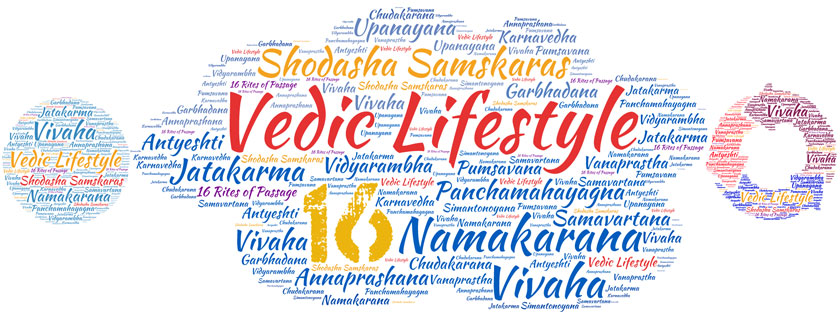
1. Garbhadana Samskara – is performed by a married couple when conceiving a child. This important Samskara raises the act of conception to a sacred occasion, and is powerfully purifying and uplifting for the unborn child.
2. Pumsavana Samskara – is usually performed between the second and fourth month of pregnancy. Its purpose is: to insure the good health of the foetus and the proper formation of its organs, so that the family line and tradition will perpetuate thorugh the baby.
3. Simantonoyana Samskara – In the fourth or fifth month of pregnancy, the mind of the foetus begins to develop. This is when simantonoyana Samskara is performed. Its purpose is to protect the foetus–especially its newly forming mind–from all negative influences, and also to stimulate the development of the unborn child’s intellect.
4. Jatakarma Samskara is the ritual performed at the birth of a child noting the birth time and star and thus create a birth chart which is suppose to be the blue print of ones life.
5. Namakarana Samskara – On the eleventh day after the child’s birth, namakarana Samskara is performed. In this ceremony, the child receives its name.
6. Nishkramana Samskara – The baby’s first outing into the world, beyond the confines of the home.
7. Annaprashana – The first feeding of solid food to the baby, usually in the sixth month after birth.
8. Karnavedha Samskara – usually performed in the sixth or seventh month after birth, consists of the piercing of the baby’s ear lobes, so earrings may be worn.
9. Chudakarana Samskara – At the end of the first year after birth, or during the third year, the child’s hair is shaved–all but a tuft on the top of the head. This ritual shaving of hair, performed with ceremony, prayers, and chanting of Vedic hymns, is chudakarana Samskara This Samskara is for both boys and girls.
10. Vidyarambha Samskara – begins a student’s primary education by ceremonially introducing the child to the alphabet.
11. Upanayana Samskara – initiates the formal study of the Vedas. It is one of the most important and esteemed of the samskaras. Upon performance of Upanayana, a boy traditionally moves from home to live in the ashram of the guru.
12. Samavartana Samskara – With samavartana Samskara the disciple graduates from his Vedic studies and returns from the house of his guru. Thereafter, the disciple will marry and raise a family, and so enter the stage of householder, grihasthashrama.
13. Vivaha Samskara – The traditional Hindu wedding ceremony is known as vivaha Samskara It is considered by many to be the most important of all the samskaras.
14. Panchamahayagna Samskara – A married couple performs the panchamahayajna, or five great sacrifices, daily. In this Samskara, one honours, in turn, the rishis, the gods, the parents, humankind, and all created beings.
15. Vanaprastha Samskara – According to the Vedic tradition, vanaprastha is the third stage of life, following brahmacharya (Vedic student/disciple) and grihasta (householder). Here, a one leaves behind ones life in the world and retires to the forest (or serving the society), to live an ascetic life devoted to service, study of the scriptures and to meditation.
16. Antyeshti Samskara – The final sacrament, the funeral rites, are known as antyeshti Samskara.
Comments
Post a Comment